I built my first WordPress website for a client in 2010. Since then, WordPress has paid for a large part of my life. Client websites, WooCommerce stores, custom plugins, an entire agency. Sixteen years of work by then, all standing on one free piece of software.
And in all that time, I did not know that WordPress is built mostly by volunteers. Nobody told me. I never asked how a free thing that runs such a huge part of the web keeps getting better every single year. It just did, like weather.
The answer had been sitting inside my own dashboard for years. Every WordPress install ships a small events widget that lists meetups and WordCamps happening near you. I must have scrolled past it thousands of times across hundreds of sites. I never clicked it once. Not because I did not care. Because nothing, anywhere, ever told me why I should.
And like most people, I had my own quiet assumption backing that ignorance. I believed these events were for core developers. People who maintain servers, understand Git inside out, and argue about code standards for fun. I was just someone building client websites. It never crossed my mind that there was a place in all this for people like me.
That is the actual problem this article is about. The WordPress community is brilliant at building software and surprisingly bad at explaining itself to its own users. There is almost nothing out there that tells a normal WordPress user what happens inside a meetup, a WordCamp, or a contributor day. Before my first one, I read every article I could find and still walked in clueless. If I could not figure it out after sixteen years inside this ecosystem, how would a store owner or a blogger ever figure it out?
The two sentences that explain the whole gap
Some time back I invited two friends to an upcoming WordCamp. Both have built on WordPress for years. Their replies said everything.
The first one runs a web design agency with a team of more than twenty people. He shrugged and asked me, what is there left to learn in WordPress? In his head, a WordCamp is a seminar hall. Famous people on stage giving speeches, everyone else taking notes. He has shipped websites for years, so why would he sit through a lecture about things his team already does every day? His entire business runs on WordPress, yet he has never met the community behind it.
The second one panicked in the opposite direction. He builds his sites with visual builders and has never written a line of code. He was convinced that people at a WordCamp would test his WordPress knowledge, throw technical questions at him, and he would stand there exposed as not a real developer.
A classroom you think you have outgrown. An exam you are afraid you will fail. Both pictures are completely wrong, and both were enough to keep two capable professionals at home. Nobody gives you homework at a WordCamp. Nobody takes your interview at the door. Half the hall is not even developers. It is bloggers, store owners, designers, marketers, people who have never opened a code editor and never plan to. But if people who work on WordPress daily believe these things, the community has an education problem, not an attendance problem.
I know, because I carried my own version of those wrong pictures for most of my career.
And here is the part nobody tells first-timers. Even the word conference gives you the wrong idea. Looking back, the talks are almost the smallest part of a WordCamp. The real event happens in the hallways, at the lunch tables, at contributor day, in random introductions and the conversations that refuse to end after hours. That is where the actual learning hides, and no schedule page will ever show it to you.
The first WordCamp I walked out of
Mumbai was not actually my first WordCamp. A year earlier there was another one, in another city, and it very nearly became my last.
I found it through that widget. An event turned up in my dashboard, one city away, and after all those years of scrolling past that box I finally clicked it. Then I called a friend. Somewhere in that phone call a one day conference turned into a week off. We were going for the WordCamp, and around the WordCamp we were going to do the city.
Almost nothing about that day worked for us. Two halls, fifty metres apart, both running talks at the same time, and no sensible way to tell which of the two deserved your next hour. Fifty metres sounds like nothing until you are walking it back and forth all morning, and I am not built for sprinting between rooms, especially not for a talk that turns out to be someone pitching their own product from the stage.
The coffee never stopped, and I made full use of it. The swag ran out somewhere before it reached us. Nobody had explained what any of this was actually for, and we did not know enough to ask.
By lunch we had stopped pretending. We had a whole week in that city and no reason to spend any more of it in this hall. We walked out of the venue, got into a car, and drove forty kilometres across the state border to eat somewhere else. An hour of driving each way felt like a better afternoon than the one waiting for us inside.
That should have been the end of the story. Two people who tried a WordCamp once, decided it was not for them, and never went back.
A few weeks later my friend spotted a face on LinkedIn that we both recognised, a man who had asked a question from the audience that day. We did not know him at all. My friend messaged him anyway, just to ask what these events were actually for. A stranger owes you two lines back. This one suggested coffee, and the two of them sat there talking for three hours.
His advice was simple, and a little annoying to hear. One bad experience is not the whole picture. Go again.
So when WordCamp Asia landed in Mumbai a few months later, we went.
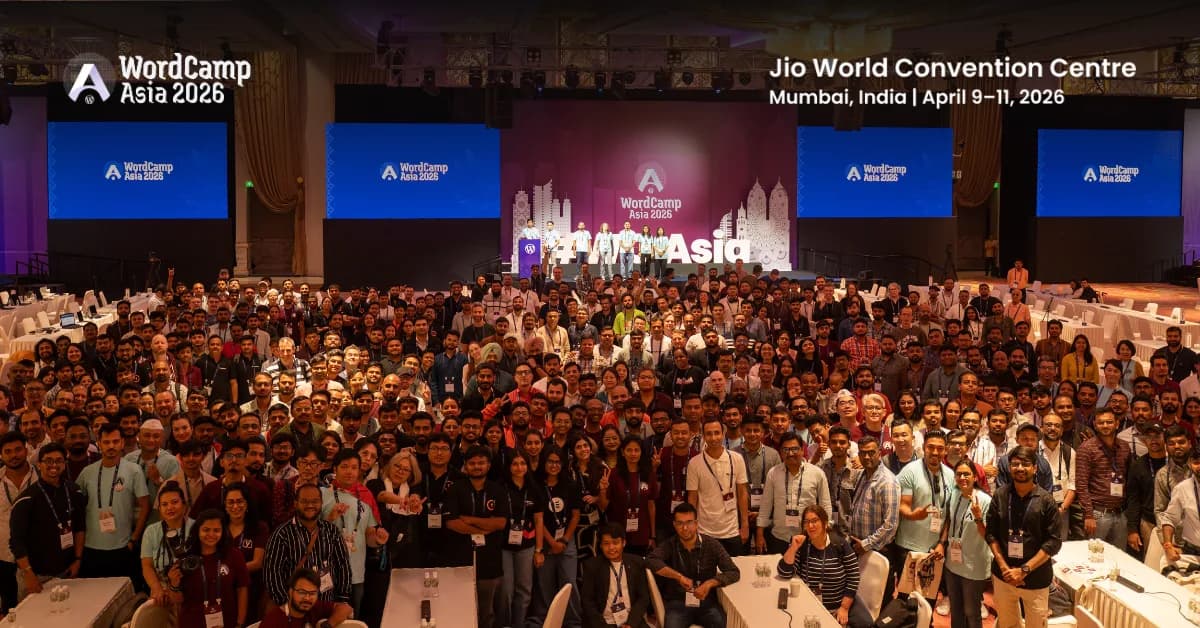
Fifteen hundred people, and me
WordCamp Asia 2026 happened in Mumbai. My own city. Whatever excuses I had left, they all expired at once.
The registration emails kept telling me to book a seat for something called contributor day. I booked one without understanding what I was booking.
I had a hundred visiting cards printed for that WordCamp. Fresh, for the occasion. I carried all hundred into the hall and I carried all hundred home again. Not one of them changed hands. That is the person who was now walking into more than fifteen hundred people, nearly all of whom I assumed were smarter than me. Reaching the venue was my Everest, and I had climbed it before the day even started. Everyone has their own Everest.
The same friend came with me, equally clueless. He went scouting across the hall, came back, and we picked the table that sounded the most exciting, the Core AI table. Our plan was simple and lazy. AI was new in WordPress core, so we would casually test some AI features, get our contribution counted, and go home as heroes.
We sat down and asked the table lead where to start. His answer was a checklist, not a task. Get a local environment running first. A local WordPress, Git, Docker. Then come back.
So we started building it, right there at the table, on venue wifi. Pulling packages, waiting on containers, watching a local WordPress refuse to come up. We kept looking up, expecting him to swing back around and unblock us. Everyone else was already flying and he stayed with the people who had arrived prepared. Maybe he was overloaded. Maybe two half-installed laptops did not look worth the time. I am not blaming him. He never came back, and we spent two hours at a contributor day contributing nothing but download progress.
Those two hours taught me my first honest lesson about this world. The ecosystem writes endlessly about why you should contribute, and almost nothing about how lost a first-timer actually feels in the room.
What a contributor day actually looks like
So let me do what those articles never did for me.
A contributor day is a hall full of tables, and every table belongs to one WordPress team. Core, Polyglots, Documentation, Support, Design, Photos, Community, and more. Each table has a lead, usually an experienced contributor, whose whole job that day is to turn strangers into contributors. You walk in, pick a table, take a chair. That is the entire protocol. Nobody checks what you do for a living and nobody asks how long you have used WordPress.
Make one thing before you arrive: a wordpress.org account. It is the login for the handbooks, the translation platform, the support forums and the Slack where every team actually talks. It takes two minutes at home, and venue wifi will stretch those two minutes into ten.
Then the part that decides your whole day. Tables are not equal. Polyglots, Documentation, Support and Photos need nothing but a laptop and that account, and you can be contributing inside ten minutes of sitting down. The code tables are a different sport. Core and its sister projects expect a working local development environment, Git and all, before you are any use to them. If you want a code table, arrive with it already running. Not installed. Running.
Turnout at WordCamp Asia 2026, as reported in the organisers’ contributor day recap.
You are also allowed to leave a table, and this is the one I most wish somebody had told me. Nothing binds you to the chair you picked first. Sitting at the wrong one all afternoon out of politeness helps nobody, least of all the team you are sitting with.
When you do sit down, ask the lead for a task rather than for advice. What should I work on gets you further in one sentence than an hour of looking capable. They keep a list of things that need doing. That list is the reason they are sitting there.
And it is a working day, not a talk. People arrive, open laptops, and get on with it. There is lunch, there is coffee, and the conversations around both are worth as much as the work.
Two of those paragraphs, read before that morning, would have changed my whole day.
My first pull request, thanks to AI
Most contribution stories skip this part. I will not.
What finally unstuck us was an AI coding assistant and a mobile hotspot. I gave up on the venue wifi, tethered the laptop to my own phone, and started the setup again with the assistant walking me through it line by line. This time it came up. Then it helped me shortlist an open issue from the repository, reproduce the bug on my machine, and shape a fix. I had written plenty of PHP for clients over the years, but I had never touched Git, the CLI, or a local core setup. Those were the walls, and AI walked me around them. Sitting in that hall, I opened the first pull request of my life.
My nerves stayed a wreck through the whole thing. Then I clicked submit, shut the laptop, and walked to lunch like a man who had finished a full day of work. I had no idea what happens to a pull request after you open one. I assumed some machine somewhere accepts it and moves on.
The afternoon that explained everything
After lunch I did not pick a table. It had already been picked for me, the night before, over ice cream.
The man from LinkedIn, no longer a stranger, was in Mumbai for the same event. My friend worked out that his hotel stood five hundred metres from ours. We went out for chai and somehow ended up eating ice cream on the street close to midnight, the four of us, because he had brought along someone else from his city. That someone turned out to be running the Polyglots table the next afternoon, the team that translates WordPress into the world's languages.
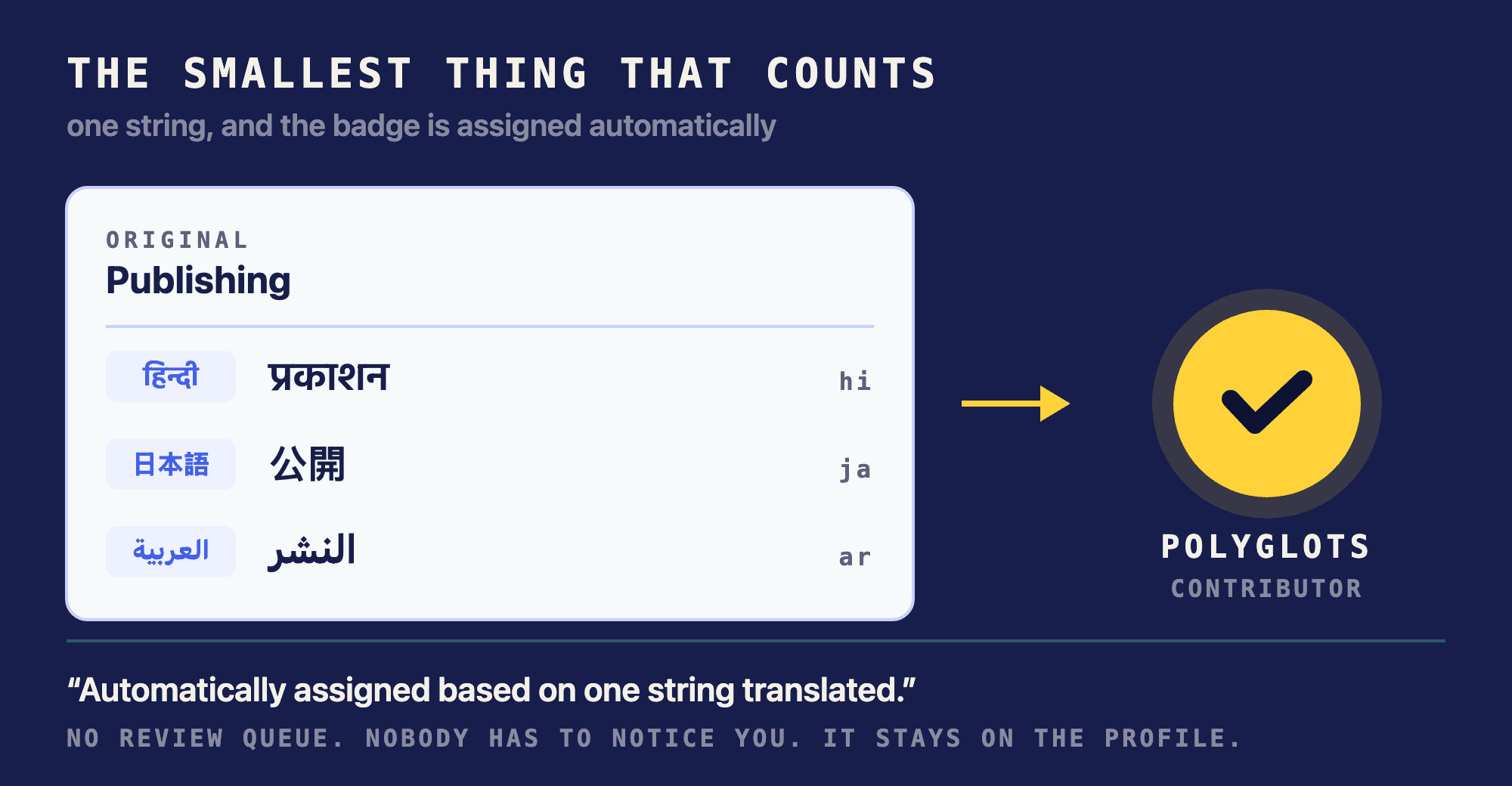
He waved me over when he saw me. Sit here, he said, and translate some strings into a language you actually speak. So I picked Hindi.
And there I met the other kind of table lead. The kind who owns his job.
For the next few hours I ground through translations, and between my own doubts I just sat and listened to him work. He must have answered a hundred questions that afternoon. Mine, and everyone else's around that table. Complete beginners asking the same thing twice, and he answered the second time with the same patience as the first.
Sitting there listening, something else slowly sank in. Every single person at that table had been new once. The lead answering his hundredth question, the reviewer approving strings, all of them had a first clueless day like mine. Nobody in this world was born a contributor.
Same event. Same day. Two tables, two completely different weathers. I have thought about that contrast a lot since. One patient person at a table is the difference between someone's first contribution and someone's last attempt.
Somewhere in that afternoon the WordCamp I had walked out of came back to me, and it looked nothing like it had at the time.
Every part of that day I had complained about was somebody's unpaid weekend. The signage that would have told us which hall to be in. The person who should have been at the desk explaining what any of it was for. The talk nobody had screened before it turned into a product pitch. None of those are failures of an organisation. Each one is a gap where a volunteer was missing.
There was nobody to be angry at. A room had been short of people willing to help run it, and I had been sitting in that room the whole time, being annoyed, as if it was somebody else's job.
That afternoon I translated more than fifty strings of WordPress 7.0 into Hindi. But the real thing I took home was his explanation of what contribution actually is. Not one heroic patch to core. Many small pieces of work, spread across many teams, done in your own time, at your own pace, with nobody rushing you. That one conversation did more for me than every article I had read. In a way, the article you are reading right now exists because of that afternoon.
Submitting is not the finish line, it is the starting gun
That belief did not survive the week.
The maintainer of that repository came back with comments. Not one verdict on the whole thing, but notes left on individual pieces of the code. Is there a reason we are not using the helper that already exists here, instead of a new one. What is the thinking behind this bit. What happens in this case. Nothing in any of it was unkind. It was somebody doing their job carefully. It still gave me a small heart attack every time a notification arrived, because I was convinced that any day now he would lose patience and throw me out of his repository.
He never did. He questioned, guided, and pushed back until the fix was actually right. A week after I opened it, the pull request was merged. A few days after that, when the fix shipped in a release, the first badge turned up on my wordpress.org profile. Core AI. Somewhere between the panic and that badge, I got hooked.
What followed was the most addictive week I have had in years. Awake till six in the morning, every night, hunting for new issues, fixing review comments, jumping from repository to repository. WordPress has more than 200 repositories on GitHub. I did not know that before. Suddenly every one of them looked like an open door.
And yes, the badges. Your wordpress.org profile collects a badge for each area you contribute to, and I chased them openly, like stamps in a passport. It sounds a little childish to admit. It was also completely worth it, and half the ecosystem quietly does the same.
Translations checked on translate.wordpress.org. Badge rule quoted from the Meta handbook.
The translations had their own arc. My early submissions collected an embarrassing pile of rejections. Wrong glossary terms, missing context, casual mistakes. A few months earlier I could not have told you what a translation glossary even was. Slowly it started making sense, then the context did, and the approvals began to outnumber the rejections.
These days I review Hindi translations for a few plugins myself. The role has a fancy name, Project Translation Editor, and it sounds far grander than it is. You read other people's strings and click approve or reject, the same process that used to reject mine. Mostly it means I try to be patient with beginners, because someone was patient with me.
What came back to me
Let me be straight about this part. Contributions and badges do not pay bills. Nothing on a wordpress.org profile has ever settled an invoice.
But contribution is not charity either, and open source is not a donation box where kind developers occasionally drop some free time. It is an ecosystem. The more you put into it, the more knowledge, trust, friendships and opportunities flow back to you, sometimes immediately, sometimes years later. It returns more than it takes, just not in the currency you expect.
The WordPress Slack turned out to be full of helpful people. My inbox there slowly filled with thank you messages from maintainers and reviewers of repositories far bigger than anything I run, including people working at Automattic. People sitting oceans away, who I may never get to meet in person, taking a minute out of their day to tell me the work helped. That feeling has not faded yet.
A small CLI package I built got a comment from a stranger saying, this should be in core. For someone who could not set up Git a few months earlier, that one line felt like a trophy.
Because of that wordpress.org profile and its badges, I was approved for Claude's open source contributors program, which gave me six months of their highest plan, free. I used it to build my own plugins and contribute further. Notice the loop there. Contribution unlocked tools, tools unlocked more contribution. It compounds like interest.
Then it turned into work. I built a plugin of my own and posted about it in a small online community of the people it was built for. Nobody there knew me. The plugin did the introducing. What came back that time was not thank you messages, it was enquiries, and some of those turned into paid projects. The badges still do not pay. What they set in motion eventually did.
Then there is the part nobody warns you about, because it sounds too simple. The big names are not behind any velvet rope. I expected maintainers, release leads and famous plugin authors to be surrounded by crowds. Instead they were standing in coffee queues, chatting with whoever walked up. I shook hands with developers whose plugins run on my client sites right now, and said thank you in person. The distance between a random community member and the person who built the thing you use every day turned out to be almost zero.
Honestly, that was the biggest surprise of this whole journey. Not the merged pull request. The discovery that this community is full of people who genuinely want a newcomer to succeed.
The ripple does not stop with you either. The friend who walked clueless into that hall with me now works to keep WordPress meetups running in his own city, and has since joined the organizing team of a WordCamp. One contributor day, and the circle keeps widening.
And for my clients, it means something quieter. Before contributing, WordPress was simply software I installed for people. Today, when a client reports a bug, I have a fair idea of where that bug probably lives, how releases get discussed, how issues get triaged, and who to ask when something looks strange. I stopped being only a consumer of WordPress and became a small part of the system that builds it.
Contributing even changed how I build websites. I follow discussions before features ship, so a new release rarely surprises me. When a client asks why something changed after an update, I usually know the story behind the change, not just the changelog line. That is a different kind of confidence, and it flows straight back into every site we look after.
The uncomfortable part about AI
AI took me from zero to an open pull request in a single afternoon, so I get to say this without any hypocrisy.
There is a pattern growing in open source that nobody enjoys talking about. Pull requests opened by AI in bulk and then abandoned. A maintainer reads the code, asks a question, and hears silence forever, because no human was ever really behind the work.
It is tempting to call this badge farming, but most badges only arrive once something is actually merged, and abandoned work never gets that far. Which makes it worse rather than better. Nobody collects anything at the end of it. The only thing that definitely changes hands is the reviewer's afternoon.
The numbers say this is not a small leak. Daniel Stenberg, who created cURL, called what was arriving death by a thousand slops, and in January 2026 he ended the project's bug bounty outright. Reports that turned out to be real vulnerabilities had run north of fifteen percent for years. By 2025 they were under five. Tidelift's 2024 survey sets the wider scene: sixty percent of open source maintainers are unpaid, and close to sixty percent have quit or considered quitting, mostly from burnout. AI made writing code easy. It made reviewing code harder. And reviewers were already the scarcest people in open source.
Understand what AI actually did in my story. It did not replace the reviewers. It helped me reach them. Every line I submitted was still read, questioned and improved by experienced humans who explained what worked, what did not, and why. That review is where the real learning lives, and it only happens if you stay present for it.
So here is the one rule I follow, having lived both sides. Use AI as much as you want. I do, daily. But never open a pull request you do not intend to stand behind. Answer the review comments. Understand your own fix. Own the work with your name. A tool opening PRs with no human behind it is not contribution. It is noise wearing contribution's clothes.
There are a thousand ways in, and most need zero code
If the coding parts of this story scared you, this section is the one I wish someone had shouted at me long ago.
WordPress runs more than twenty contribution teams, and code is just one of them. Photographers contribute images to the WordPress Photo Directory. Video folks record WordCamp talks, and others add captions and subtitles so those talks reach people in every language. Writers fix and improve documentation. Translators carry WordPress into their own languages, one string at a time. Designers, accessibility testers, forum helpers, podcast makers, marketers, meetup hosts, event volunteers. There is media work, journalism, teaching, organizing. Easily a thousand different ways in.
It goes even smaller than that, and it still counts. Answering one confused user in the support forums is contribution. Testing a beta release on a spare site and reporting what broke is contribution. Opening one clear, well-written issue is contribution. Even leaving an honest comment telling someone their work helped you is contribution. I attend the WP Mumbai and WP Thane meetups now, and half the value is just the conversations.
One more barrier I should break for you. Nobody measures any of this. There is no minimum hours, no attendance register, no manager. Nobody asks why you disappeared for two months when work got busy. You contribute when life allows, and when you come back, people are simply happy to see you again.
And if contribution is not your thing yet, come anyway. Come for the coffee, the swag and the conversations. Nobody at the gate asks what you plan to give. Plenty of people attend their first WordCamp just to look around, and that is a completely respectable way to begin.
The community does not need you to be a developer. It needs you to show up.
You do not even have to leave your house
Everything so far in this story happened inside a hall with fifteen hundred people in it. If that is the wall stopping you, this part is for you.
None of it actually requires a hall. Translating strings on translate.wordpress.org, answering one thread in the support forums, testing a beta release on a spare site, fixing a wrong line in the documentation, leaving one honest comment telling someone their work helped you. All of it happens from your own desk, at midnight, in your pajamas, with nobody watching.
No classroom you think you have outgrown. No exam you are afraid to fail. No table lead deciding whether you look prepared enough. No room full of strangers to feel small in front of. Just you and one open tab.
Ten minutes between two client calls. An hour on a slow Sunday. Whichever you pick, nobody is counting either one.
A room full of people who care about the same software is its own kind of thing, and I would not trade that afternoon in Mumbai for anything. But none of this is the consolation prize. Most contribution to WordPress never happens at an event at all. It happens exactly like this, on ordinary days, at ordinary desks, by people fitting it around everything else in their lives. A WordCamp is one way in. It was never the door.
Sixteen years was too long
Months into this, I am still a newcomer in many ways. Still learning, still getting corrected, still asking basic questions in Slack. That is not a confession, that is the point. You do not graduate into contribution one day. You just keep showing up, and the showing up is the whole job.
WordPress stays alive because ordinary users, at some point, decide to give a little back. I took from it for a decade and a half before I understood that. You do not have to wait that long.
The community needs you. And trust me on this one, you need the community too.
Start ridiculously small. Open your WordPress dashboard and find that events widget, the one you have been scrolling past all these years, and click it once. See what is happening near you. That single click is how this whole story started for me.
And when you land at your first meetup or WordCamp, do the one thing I could not. Walk up to any table, any volunteer, and ask one simple question. What can I contribute? I never managed to ask it. Somebody had to spot me and wave me over instead, and not everyone gets that lucky. Your story is one question away.